 Biours


For skincare brands, formulation laboratories, ingredient suppliers, and product development teams, the exhibition offers a focused setting for technical discussions. Unlike broad consumer beauty fairs, Cosmet’Agora places cosmetic formulation at the center of its program.
That distinction matters for businesses developing hydrogel eye patches, facial masks, and other skincare products. Selecting ingredients is only the beginning. Brands must also understand material compatibility, product stability, manufacturing feasibility, and the evidence needed to support their claims.
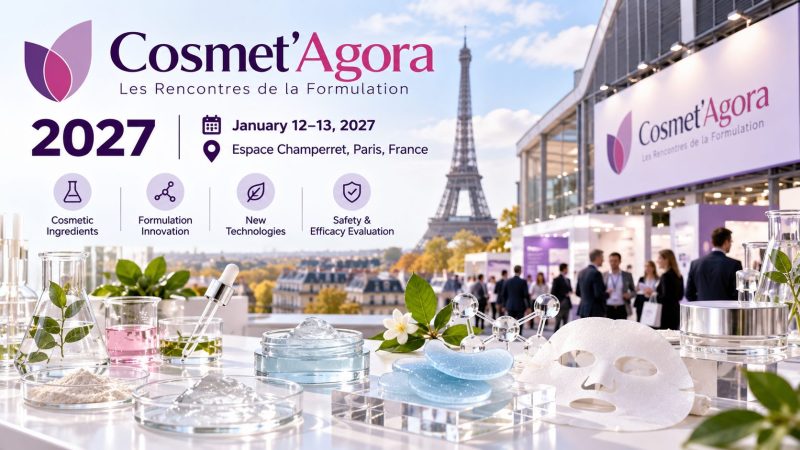
1. Cosmet’Agora 2027: Dates, Venue and Organizer
The 19th edition of Cosmet’Agora is scheduled for two days in Paris. The event is organized by the French Society of Cosmetology, an organization dedicated to cosmetic science and professional knowledge exchange.
| Event Information | Details |
|---|---|
| Event Name | Cosmet’Agora 2027 |
| Edition | 19th edition |
| Dates | January 12–13, 2027 |
| Opening Hours | 9:30 AM–6:00 PM |
| Venue | Espace Champerret, Paris, France |
| Organizer | Société Française de Cosmétologie (SFC) |
| Admission | Free visitor entry; registration details to be confirmed |
| Official Website | Cosmet’Agora Official Website |
According to the organizer, the exhibition covers raw materials, cosmetic textures, emerging technologies, and methods for evaluating product safety and efficacy. Visitors should check the official website for updated registration and exhibitor information before attending.
2. Why Cosmet’Agora Matters to Cosmetic Product Development
Beauty brands increasingly need to connect attractive product concepts with measurable technical performance. Consumers may notice texture, comfort, and packaging first. However, formulators must consider a much wider range of requirements.
For example, an active ingredient may perform well in one formulation but behave differently in a hydrogel matrix. Likewise, a visually appealing patch may still require adjustments to moisture retention, adhesion, or packaging protection.
Cosmet’Agora brings these technical questions into a professional environment. Ingredient suppliers can discuss material properties, while formulators and manufacturers can explore practical development constraints.
For purchasing managers, this creates an opportunity to ask better questions before approving a new supplier or product concept.
3. Cosmetic Ingredients and Emerging Formulation Trends
The event’s central themes include raw materials, textures, new technologies, and evaluation methods. These subjects are relevant to skincare businesses seeking differentiated products without overlooking performance or safety.
Functional Ingredients and Skin Care
Humectants, conditioning agents, polymers, and selected cosmetic actives can influence the sensory experience and performance of a skincare formula. Nevertheless, their suitability depends on concentration, compatibility, stability, and the intended product format.
Brands should evaluate an ingredient within the finished formulation rather than relying exclusively on supplier marketing claims.
Texture and Sensory Innovation
Texture is an important part of skincare positioning. Consumers may prefer a lightweight serum, a rich cream, or a cooling gel-based patch. Each format creates different formulation and manufacturing requirements.
For hydrogel products, the balance between flexibility, moisture, structural integrity, and skin feel deserves particular attention.
Safety and Efficacy Evaluation
Product testing supports informed development decisions. Depending on the formulation and target market, this may involve stability studies, microbiological assessment, packaging compatibility, skin compatibility, and claim-specific efficacy testing.
However, one successful test does not automatically substantiate every marketing claim. Brands should define their intended claims before selecting an evaluation program.
4. Hydrogel Skincare Formulation: From Concept to Finished Product
Hydrogel technology offers a distinctive format for skincare products. A water-containing polymer network can provide a flexible structure suitable for certain patch and mask applications.
Yet the finished product depends on more than its hydrogel base. Formulators must consider the complete system, including ingredients, material structure, processing conditions, packaging, and intended use.
| Development Factor | Why It Matters |
|---|---|
| Hydrogel Matrix | Influences flexibility, structure, moisture behavior and product handling |
| Active Ingredients | Require compatibility assessment within the finished formulation |
| Skin Feel | Affects consumer comfort and product positioning |
| Adhesion and Fit | Influence application, removal and the intended wearing experience |
| Stability | Helps assess performance under defined storage conditions |
| Packaging | Protects product integrity and supports practical distribution |
For example, a brand developing a premium under-eye patch may want a comfortable fit, a consistent appearance, and a pleasant application experience. The manufacturer must translate those expectations into achievable specifications.
Companies exploring this category can review hydrogel eye patch manufacturing to understand potential private label product development opportunities.
5. Formulation Stability and Quality Control
Stability testing is a critical stage in cosmetic product development. A product that looks satisfactory immediately after production may behave differently after storage, shipping, or exposure to temperature changes.
For hydrogel masks and patches, brands should consider physical appearance, moisture behavior, packaging integrity, and other relevant quality attributes.
Moreover, testing conditions should reflect the product’s intended distribution and storage requirements. A supplier’s standard test program may not address every destination market or commercial use case.
Therefore, purchasing teams should agree on specifications, test methods, and acceptance criteria before approving mass production.
6. OEM vs ODM: Choosing the Right Development Model
Ingredient innovation becomes commercially valuable only when brands can turn a concept into a consistent finished product. This is where an experienced manufacturing partner can contribute.
Under an OEM arrangement, production generally follows specifications agreed with the brand owner. An ODM project may involve broader assistance with product design, formulation development, material selection, and packaging.
The right model depends on the buyer’s internal capabilities, intellectual property requirements, budget, and launch schedule.
| Buyer Requirement | Possible Manufacturing Approach |
|---|---|
| Established Product Specification | OEM manufacturing against agreed technical requirements |
| New Product Concept | ODM development with feasibility and sampling stages |
| Private Label Collection | Product selection, artwork and packaging customization |
| Special Texture or Material | Technical evaluation and formulation trials |
| International Market Launch | Quality documentation, labeling review and export coordination |
Foshan Biours Biosciences Co., Ltd. works with international businesses developing hydrogel-based products. Its OEM and ODM manufacturing services support discussions around product concepts, customization, manufacturing feasibility, and packaging.
For brands building their own skincare collections, private label hydrogel solutions may provide another starting point.
7. What European Skincare Brands Should Ask Suppliers
European buyers need more than an attractive sample. They must understand whether the manufacturer can deliver consistent quality and provide the information required for the intended market.
Before choosing a partner, brands should ask several practical questions:
- Formulation: Which ingredients and material properties can be customized?
- Testing: What stability, compatibility, and safety evidence is available?
- Documentation: Can the supplier provide appropriate specifications and supporting records?
- Production: What are the minimum order quantity, sampling stages, and expected lead times?
- Packaging: Can the manufacturer support different sachets, cartons, and labeling requirements?
- Quality: How are production changes, batch consistency, and nonconforming products managed?
For cosmetic products entering the European Union, the responsible business must also address applicable regulatory requirements. These can include a safety assessment, Product Information File, responsible person, notification, and compliant labeling under the EU cosmetics framework.
Manufacturing support does not replace the brand owner’s regulatory responsibilities. Consequently, buyers should involve qualified regulatory specialists before placing products on the market.
8. Innovation Opportunities for Hydrogel Eye Patches and Masks
Hydrogel skincare products allow brands to explore different product experiences and positioning strategies. However, meaningful differentiation should come from verified product characteristics rather than unsupported claims.
Potential development directions include improved fit, convenient single-use packaging, distinctive sensory profiles, and formulations designed around clearly defined cosmetic objectives.
For facial care collections, hydrogel facial mask manufacturing provides another area for technical and commercial evaluation.
Brands should also consider whether their proposed ingredients remain compatible with the selected hydrogel structure throughout the intended shelf life.
By resolving these questions early, product teams can reduce unnecessary reformulation and avoid costly changes close to launch.
9. How to Prepare for Cosmet’Agora 2027
Because Cosmet’Agora focuses on technical formulation, visitors can benefit from preparing specific development questions rather than relying on general product brochures.
- Identify a formulation challenge. Define the texture, stability, compatibility, or performance issue you want to address.
- Review relevant exhibitors. Look for ingredient suppliers, laboratories, testing specialists, and technology partners.
- Prepare technical questions. Ask about material properties, recommended use conditions, and supporting evidence.
- Discuss manufacturing feasibility. Consider whether a proposed formulation can be produced consistently at commercial scale.
- Document follow-up actions. Request samples, technical documents, quotations, and realistic evaluation timelines.
The organizer also presents a Formulation Award as part of the event. Its 2027 theme, “Art et Audace,” highlights the relationship between creative concepts and formulation work. Visitors interested in innovation can follow the award information through the official organizer.
10. About Biours: Hydrogel Product Development and Manufacturing
Foshan Biours Biosciences Co., Ltd. is a China-based manufacturer specializing in hydrogel product development and manufacturing. The company serves international skincare brands, importers, distributors, and private label businesses.
Its product experience includes hydrogel eye patches, facial masks, cooling patches, and customized hydrogel formats. Development discussions may cover product specifications, materials, packaging, sampling, and production planning.
For additional company information, visit About Biours.
Biours is not presented as a confirmed exhibitor at Cosmet’Agora 2027. This article provides independent industry information and explores how formulation trends may inform hydrogel product development.
11. Final Thoughts
Cosmet’Agora 2027 offers a focused opportunity to explore cosmetic ingredients, formulation techniques, and evaluation methods. For brands developing hydrogel skincare, its technical emphasis is especially relevant.
Successful innovation requires more than selecting fashionable ingredients. It depends on formulation compatibility, reliable testing, manufacturing consistency, and clear product positioning.
Skincare brands seeking hydrogel OEM/ODM manufacturing support can contact Biours at [email protected] to discuss customized eye patches, facial masks, and related product development requirements.