 Biours


The exhibition covers baby care products, nursery essentials, children’s fashion, footwear, toys, and related categories. For international buyers, it provides a valuable opportunity to explore European sourcing trends and establish new commercial relationships.
It is also relevant to brands considering private label baby care products, customized skin-contact materials, and hydrogel-based product development. However, selecting a suitable manufacturer requires careful attention to product safety, intended use, and regulatory requirements.
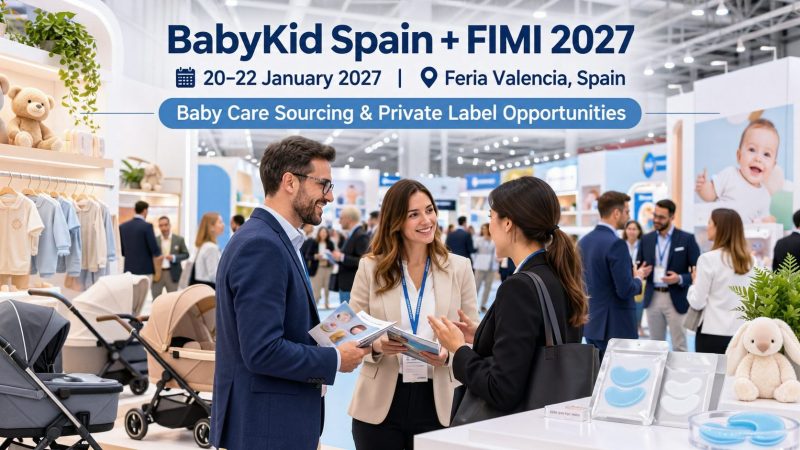
1. BabyKid Spain + FIMI 2027: Dates, Venue and Organizer
BabyKid Spain + FIMI is a professional trade exhibition dedicated to the children’s product industry. The 2027 event will be held in Pavilion 7, Levels 2 and 3, at Feria Valencia.
| Event Information | Details |
|---|---|
| Event Name | BabyKid Spain + FIMI 2027 |
| Edition | 7th edition |
| Dates | January 20–22, 2027 |
| Venue | Feria Valencia, Pavilion 7, Levels 2 and 3 |
| Address | Avda. de las Ferias s/n, 46035 Valencia, Spain |
| Organizers | Feria Valencia and ASEPRI |
| Visitor Type | Trade professionals and qualified buyers |
| Official Website | BabyKid Spain + FIMI Official Website |
Visitor hours are scheduled for 9:00 AM to 7:00 PM on January 20 and 21, and 9:00 AM to 4:00 PM on January 22.
According to the organizers, the January 2026 edition brought together 730 exhibiting brands and 4,800 professional buyers. These historical figures illustrate the event’s international reach but should not be treated as confirmed attendance for 2027.
2. Why Valencia Matters for European Baby Product Sourcing
Spain offers international brands access to established European retail and distribution networks. Valencia provides a meeting point for suppliers, specialized retailers, purchasing agents, and children’s product businesses.
BabyKid Spain + FIMI combines multiple product categories in one professional setting. As a result, buyers can compare different product concepts and identify potential distribution opportunities during a single visit.
For manufacturers and importers, the event also creates opportunities to understand European expectations for design, packaging, safety, and product presentation.
Nevertheless, brands should not assume that a product suitable for one country automatically meets the requirements of every European market.
3. Key Baby Care and Children’s Product Categories
The exhibition covers a broad range of products for babies, children, and families. Its official categories include nursery equipment, transport products, textiles, toys, footwear, and children’s fashion.
| Product Category | Potential Buyer Interest |
|---|---|
| Baby Care and Nursery Essentials | Everyday products, materials, product safety and brand positioning |
| Transport and Mobility | Pushchairs, travel equipment and related accessories |
| Baby Textiles | Comfort, material quality, packaging and retail presentation |
| Children’s Fashion and Footwear | Seasonal collections, design trends and distribution partnerships |
| Toys and Development Products | Age suitability, safety requirements and retail assortment planning |
| Private Label Opportunities | Supplier evaluation, customization and commercial manufacturing discussions |
For baby care businesses, the event is particularly useful for identifying market positioning and understanding how brands communicate product safety and quality.
However, the exhibition is not exclusively focused on skincare or hydrogel materials. Buyers seeking specialized skin-contact products may need additional discussions with dedicated manufacturers.
4. Private Label Baby Care: Opportunities for International Brands
Private label manufacturing allows retailers, distributors, and emerging brands to develop products under their own trademarks.
Depending on the supplier, customization may involve product specifications, materials, dimensions, packaging, and artwork. Some manufacturers also support sampling and product development.
For a new brand, an established product format may simplify the initial development process. Meanwhile, a more differentiated concept may require additional testing and manufacturing adjustments.
Before requesting quotations, buyers should define the intended user, age range, destination market, and expected product claims.
Brands considering hydrogel-based formats can explore private label hydrogel manufacturing solutions and discuss whether a proposed product concept is technically appropriate.
5. Hydrogel Cooling Patches: Product Development Considerations
Hydrogel patches use water-containing polymer materials that can be manufactured in flexible sheet formats. Depending on their formulation and design, selected products may provide a cooling sensation during application.
However, a cooling sensation does not establish that a patch treats fever, relieves pain, or provides a medical benefit. Any such claim requires appropriate evidence and regulatory assessment.
For products intended for babies or young children, additional precautions are essential. A general-purpose hydrogel patch should never be assumed suitable for infant use without appropriate design evaluation and supporting safety evidence.
Skin Compatibility
Young children’s skin may have different sensitivities and exposure considerations. Brands should evaluate ingredients, materials, and intended contact duration for the specified age group.
Adhesion and Detachment Risks
Patch size, adhesion, removal characteristics, and the possibility of detachment require careful assessment. Product design should consider foreseeable misuse and age-related hazards.
Packaging and Labeling
Packaging should protect product integrity and provide clear instructions, warnings, storage conditions, and age-related restrictions where applicable.
Importantly, these requirements must be evaluated for the finished product rather than inferred from the properties of its raw materials.
6. OEM vs ODM Manufacturing for Baby Care Brands
OEM and ODM arrangements can support different stages of private label product development.
Under an OEM model, a manufacturer generally produces according to agreed specifications. An ODM project may include broader assistance with product structure, material selection, development, and packaging.
However, neither approach removes the brand owner’s responsibility to understand the product’s intended use and destination-market requirements.
Foshan Biours Biosciences Co., Ltd. provides hydrogel OEM and ODM manufacturing services for international brands, importers, and distributors.
Potential projects can involve technical feasibility discussions, sampling, product specifications, and packaging customization. Products intended for infants or children require separate suitability and safety assessment before commercialization.
7. How to Evaluate a Baby Care Manufacturing Partner
Product appearance and unit price are important, but they are not sufficient for selecting a reliable supplier.
Buyers should request clear technical information and verify that the manufacturer can meet the requirements of the proposed product.
| Evaluation Area | Questions to Ask |
|---|---|
| Intended Age Group | Which age groups are covered by the product design and safety evidence? |
| Material Safety | What ingredient and skin-contact assessments are available? |
| Product Testing | Which stability, compatibility and relevant safety tests have been performed? |
| Quality Management | How are raw materials, production batches and finished products controlled? |
| Customization | Which sizes, materials, packaging formats and designs are feasible? |
| Commercial Terms | What are the MOQ, sample costs, lead times and payment conditions? |
| Documentation | Can the supplier provide applicable specifications, test reports and certificates? |
Buyers should verify certificate validity and scope. A factory’s quality management certification does not automatically establish that every product is approved or suitable for children.
In addition, technical specifications and testing responsibilities should be agreed upon before commercial production begins.
8. European Safety and Regulatory Considerations
European market requirements depend on product classification, intended purpose, age group, and marketing claims.
For example, cosmetic products must comply with applicable EU cosmetics legislation. Other consumer products may fall under the General Product Safety Regulation and relevant product-specific requirements.
A product marketed for a medical purpose may instead require assessment under the EU medical device framework. Classification should be determined before the brand finalizes claims, packaging, or market-entry plans.
Buyers should also consider traceability, labeling languages, safety warnings, and documentation responsibilities.
For products intended for children, an appropriate risk assessment should address foreseeable use and misuse. Regulatory advice and product-specific testing may be necessary.
9. How to Prepare for BabyKid Spain + FIMI 2027
A structured sourcing plan can help international visitors turn exhibition meetings into meaningful business opportunities.
- Define product priorities. Identify the baby care categories and target customers relevant to your business.
- Review the exhibitor directory. Prioritize suppliers, brands, and distributors aligned with your commercial goals.
- Prepare a purchasing brief. Include intended use, age group, destination markets, estimated quantities, and packaging requirements.
- Arrange meetings in advance. Allow time for technical and commercial discussions.
- Request supporting documents. Compare product specifications, relevant test evidence, and manufacturing capabilities.
- Plan post-show follow-up. Agree on sampling, quotations, documentation, and project timelines.
Visitors can review official admission and travel information through the BabyKid Spain + FIMI visitor information page.
10. About Biours: Hydrogel Manufacturing and Product Customization
Foshan Biours Biosciences Co., Ltd. is a China-based manufacturer with more than 20 years of experience in hydrogel product development and production.
The company serves international skincare brands, importers, distributors, and private label businesses. Its product experience includes hydrogel eye patches, facial masks, cooling patches, and customized hydrogel formats.
For buyers exploring hydrogel materials and product development, hydrogel eye patch manufacturing provides an example of the company’s established product expertise.
Additional company information is available through About Biours.
Biours is not presented as a confirmed exhibitor at BabyKid Spain + FIMI 2027. This article provides independent trade show information and discusses relevant product development considerations.
Conclusion: Building Responsible Baby Care Sourcing Partnerships
BabyKid Spain + FIMI 2027 provides an opportunity for international buyers to explore European baby care trends, compare suppliers, and establish new distribution and manufacturing relationships.
For private label brands, long-term success depends on appropriate product design, reliable manufacturing, safety evidence, and clear regulatory responsibilities.
Businesses interested in evaluating customized hydrogel products can contact Biours at [email protected] to discuss technical feasibility, sampling, and OEM/ODM manufacturing requirements.